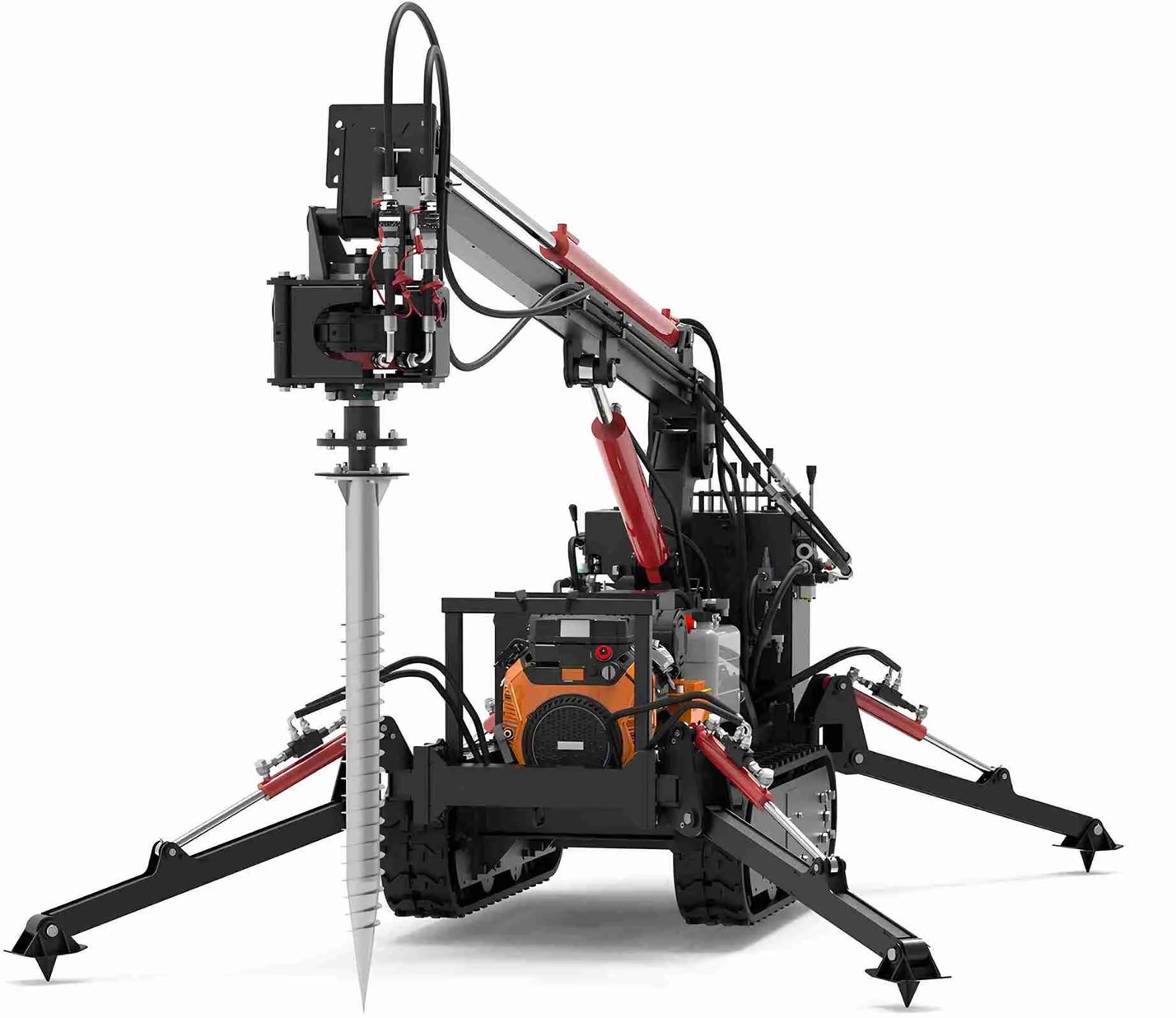
How Compact Equipment Changes Small-Site Construction
Restricted construction sites create problems that are often unrelated to the scale of the structure itself. A small extension, terrace, modular building or fence may require reliable foundations, yet the site may offer only a narrow entrance, limited turning space or finished landscaping that must remain intact. This is where specialized machinery from manufacturers such as Iron Mechanics becomes relevant for contractors working with ground screws and helical piles. Compact equipment allows foundation work to be organized around the actual conditions of the property rather than around the dimensions of a full-size excavator. The result is a different approach to site planning, transport and installation.
Large machines still have an important role in construction, especially where excavation, lifting or high production volumes are involved. Problems arise when their capacity greatly exceeds what the job requires. Bringing a large excavator to install several dozen ground screws can mean additional transport costs, greater ground disturbance and more space reserved for machine movement. A compact installation unit can perform a narrower task with fewer logistical demands. For contractors dealing with repeated small and medium projects, this specialization can be more practical than relying on multipurpose heavy equipment for every job.
Why Access Determines the Equipment Choice
Many residential projects take place behind existing houses, walls, gates or mature landscaping. The installation area itself may be large enough, but the route to it can be only a few meters wide. Even if a conventional excavator can technically reach the site, its turning radius, boom movement and total weight may make the work unnecessarily difficult. This becomes more important when the property owner expects lawns, paving or garden structures to remain in usable condition.
Compact machinery reduces some of these constraints. Smaller dimensions make it easier to pass through restricted access points, while tracked undercarriages can help the machine move over uneven surfaces. Tracks also distribute the machine’s weight over a wider area, which can reduce localized pressure on the ground compared with some wheeled machines. That does not eliminate the need for careful site assessment, but it gives contractors more options when planning the route and work sequence.
Another advantage is the ability to move from one foundation point to another without extensive repositioning of support equipment. On a small site, every unnecessary machine movement takes time and can damage the surface. A self-propelled compact unit can often reposition independently and remain close to the actual installation area. This can make the workflow more predictable, especially where dozens of ground screws must be installed according to a precise layout.
Specialized Machines Versus General-Purpose Excavators
An excavator is one of the most versatile machines on a building site. It can dig, lift, grade and operate hydraulic attachments, which explains why contractors often use it for pile-driving tasks as well. Versatility, however, comes with compromises. A machine designed to perform many functions may be larger and more expensive to mobilize than equipment built specifically for one operation.
A dedicated ground screw or helical pile machine is designed around rotational installation. Its hydraulic system, drive head, boom geometry and controls are intended to position a screw or pile and apply torque in a controlled manner. The operator does not need to adapt an excavation machine to a task that represents only a small part of its potential. This can simplify setup and make repeated installations easier to manage.
Contractors comparing specialized and general-purpose equipment should consider several practical factors:
- access width and available operating space;
- required installation torque;
- expected screw or pile dimensions;
- transport weight and machine dimensions;
- frequency of foundation installation projects;
- cost of renting or mobilizing alternative machinery.
The answer is rarely the same for every business. A large contractor with its own excavator fleet may already have suitable equipment and operators available. A smaller foundation specialist may gain more from a dedicated machine that can be transported and deployed without coordinating several pieces of heavy equipment. The important point is to compare the entire operating process rather than only the purchase price.
Mobility Can Reduce Non-Productive Time
Construction productivity is often discussed in terms of how fast a machine performs its main task. On small sites, time lost before and after that task can be equally significant. Loading, transport, unloading, access preparation and machine repositioning all affect the number of projects a crew can complete. A machine that installs piles quickly but requires complicated mobilization may offer less practical productivity than its specifications suggest.
Compact equipment can reduce these non-productive stages. Lower weight and smaller dimensions may make transport easier, depending on the machine and local vehicle regulations. Once on site, the crew can often unload the machine closer to the working area and begin positioning it without extensive preparation. Short jobs benefit most from this efficiency because mobilization represents a larger share of the total project time.
The difference becomes clear when a contractor handles several separate projects in one week. If each job requires coordination with an external excavator operator and a transport company, scheduling becomes more rigid. Delays on one project can affect the next. Owning or regularly using compact installation equipment gives the contractor more control over the sequence of work and makes smaller projects easier to fit into the schedule.
Site Disturbance Matters to Clients
Foundation work is judged not only by structural performance but also by what the site looks like afterward. Residential clients may be reluctant to approve a method that requires extensive excavation, large access routes or reconstruction of finished surfaces. Commercial clients can face similar concerns when work takes place near operating buildings, pedestrian areas or completed landscaping.
Ground screw systems are often selected partly because they can reduce excavation. Compact installation equipment supports the same objective. A smaller machine needs less room to maneuver and can reduce the area affected by construction traffic. This does not mean a site will remain completely untouched, since soil conditions and machine weight still matter. It does mean that contractors can plan the work with a smaller physical footprint.
Less site disturbance can also reduce secondary work. If paving, topsoil or landscaping does not need extensive restoration, the contractor can shorten the period between foundation installation and final handover. This can improve the economics of relatively small projects, where restoration costs would otherwise represent a disproportionate share of the budget. For clients, the benefit is easier to understand because it is visible immediately.
Hydraulic Power in a Compact Format
Small dimensions do not mean that a machine can ignore the physical demands of foundation installation. Ground screws and helical piles must overcome soil resistance, and that requires substantial torque. The challenge for equipment designers is to provide enough hydraulic power while keeping the machine manageable in size and weight. This balance determines whether compact machinery is genuinely useful or merely easy to transport.
Hydraulic systems are well suited to this application because they can deliver high torque at controlled rotational speeds. The operator needs steady force rather than rapid rotation. As soil resistance changes, the machine must continue turning the pile without sudden or uncontrolled movement. Good alignment and stable positioning remain essential because power alone does not guarantee a correct installation.
For contractors, this means that compactness should never be evaluated in isolation. A machine must still match the expected pile diameters, lengths and ground conditions. Choosing equipment only because it fits through a narrow gate can lead to problems if its torque capacity is insufficient. The correct choice combines access, mobility and hydraulic performance in one workable package.
When Compact Equipment Becomes a Business Tool
The commercial value of compact machinery increases with project frequency. A contractor completing only occasional ground screw installations may be better served by rental equipment or subcontractors. A company working on foundations every week has a different cost structure. Transport, rental minimums and external scheduling begin to influence margins more heavily as the number of projects grows.
Dedicated equipment can also allow a contractor to accept work that would otherwise be inconvenient. A small project in a restricted backyard may not justify the cost of mobilizing a large excavator. With a compact machine already available, the same project can become commercially viable. This broadens the range of jobs the company can handle without changing its core construction method.
Equipment ownership also gives the business more control over maintenance and availability. The contractor knows when the machine was serviced, which components may need replacement and whether it is ready for the next site. That control can be valuable during busy periods when rental equipment is difficult to secure. It also makes project planning less dependent on third-party schedules.
Compact foundation equipment does not replace every excavator or every installation method. Its strength lies in a narrower set of jobs where access, mobility and controlled pile installation matter more than raw machine size. On residential properties, restricted commercial sites and projects with limited working space, those characteristics can have a direct effect on cost and productivity. Contractors who repeatedly encounter such conditions can use specialized machinery to reduce logistical complexity while keeping installation work under their own control.